


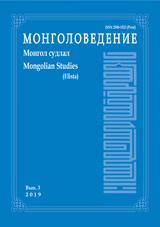
The Mongolian Studies is an Orientalist journal focusing on historical and linguistic aspects. The articles published cover the questions of history, language, folklore, and literature of Mongolic peoples primarily residing in Mongolia, China, and Russia. Typologically, works authored by Russian and foreign Mongolists include as follows: scholarly articles, reports, commented translations of written monuments, commented oral narratives, reviews and surveys. The journal comprises a range of sections, such as History, Ethnology and Anthropology, Source Studies, Linguistics, Folkloristics, and Literary Studies.
The journal chiefly aims to facilitate further development of academic Mongolian studies as an important and traditional branch of Oriental studies in Russia that started over two centuries ago and are characterized by a widest source base. It also seeks to sustain research traditions of the Russian Mongolist school and apply new methods and techniques for the investigation of topical issues relating to Mongolian studies.
The journal publishes articles in Russian, Mongolian, Kalmyk, and English.
The journal is issued four times a year.
The journal is indexed with Russian Science Citation Index, and is included in the list of peer-reviewed publications that publish key scientific results of Candidate of Sciences and Doctor of Sciences theses.
The journal was founded in 2002 by FSBIS "Kalmyk Scientific Center of the Russian Academy of Sciences" (earlier — Kalmyk Humanities Research Institute of the RAS)
Journal title versions: "Mongol Sudlal", "Mongolovedenie".
Current issue
GENERAL (WORLD) HISTORY
Introduction. In the first half of the 20th century, the territory of Inner Mongolia found itself in the thick of political and economic events and underwent a series of administrative‑territorial transformations. The socio‑economic effects of these transformations are still observable today, which undoubtedly represents high scientific interest for interdisciplinary research. Modern Inner Mongolia is a territory with unique ethno‑cultural and natural‑resource combinations, as well as industrial and agricultural features. The foundations of this were shaped by a multitude of external and internal factors in the first half of the 20th century. The goal of this article is an analysis of these factors as the prerequisites for the current economic‑geographical position of the Inner Mongolia Autonomous Region. Matherials and methods. The analysis of historical textual and cartographic materials that include new data on the processes that took place in Inner Mongolia in the first half of the 20th century are analysed in the article, on the formation of the territory’s economic structure, and on the historical prerequisites for the modern socio‑economic development of the region and the emergence of new large‑scale (global) infrastructure projects. An interdisciplinary approach based on the synthesis of scientific knowledge is relevant for addressing the research objectives in the study of this region. The combination of geographical and historical methods with source analysis has made it possible to reveal the features of the territorial economic structure and the relationships between its subsystems. Results. Among the external and internal factors thtat influenced the development of Inner Mongolia in the first half of the 20th century, it is necessary to include the transformation of nature and society against the backdrop of dynamic internal and external political processes, the implementation of major infrastructure projects and the active economic development of the territory, changes in administrative boundaries, and the formation of new administrative‑territorial entities accompanied by related migration and ethno‑cultural processes.
Introduction. The relationship between secular and religious institutions remains relevant in the 21st century and is taking on new meaning. The de facto completion of the secular project in post-socialist countries leads to the penetration of the religious element into many public spheres, including education. However, the abandonment of state atheism does not always and in all cases signify a simple return to the pre-secular state. The purpose of the study is to use the example of contemporary Mongolia, experienced a wave of “religious revival” at the turn of the 20th and 21st centuries, to trace the main trends and contradictions in Buddhist education in a post-secular society. The objectives of the study are to characterize the role of Buddhist education in pre-revolutionary Mongolia; describe the radical changes in Buddhist education during the socialist era; highlight the main trends in the development of Buddhist education in post-socialist Mongolia; and identify factors limiting interest in Buddhist education. The study’s materials include regulatory documents, official statistics, sociological surveys, and Mongolian media. Results: The process of “Buddhist revival” in post-socialist Mongolia cannot be assessed as a simple return to the pre-revolutionary situation, which is demonstrated through the case of religious education. Despite a surge in religiosity in the 1990s and support from the state and international organizations, Buddhist education in contemporary Mongolia has not regained the position it occupied in pre-revolutionary times. Compared to secular educational institutions (secondary schools and universities), Buddhist religious institutions are noticeably less popular. Social changes in Mongolian society, driven by modernization processes in the 20th and early 21st centuries, the declining social and economic attractiveness of Buddhist education among the general population, and the persistent formal secular nature of the state are the main factors behind this state of affairs. As a result, Buddhist education, while remaining a part of the country’s educational landscape, serves as a means of reproducing the clergy, which constitutes less than 0.5 % of Mongolia’s population.
NATIONAL (DOMESTIC) HISTORY
Introduction. This article examines one of the most eventful and controversial periods in the history of Russian-Mongolian economic relations — the period from 1911 to 1917. It was during this period, after Mongolia’s secession from the Qing Empire in 1911, that the Russian Empire gained control of the country’s economy. The authors analyze the evolution of Russian economic strategy in Mongolia in the context of geopolitical changes and the First World War. Goals. To identify the main stages, mechanisms, and results characteristic of the studied period of Russian economic expansion in Mongolia from 1911 to 1917. Materials and Methods. This study is based on previously unpublished documents from the state archives of the Irkutsk Region and the Republic of Buryatia. The methodological basis of the study is built on a combination of general scientific and specialized historical methods. The use of the historical-genetic method allowed the authors to conduct a thorough analysis of the reasons for the change in the economic strategy of the Russian Empire in Mongolia. The use of a statistical method made it possible to assess the development and dynamics of Russian-Mongolian foreign trade turnover. Results. The signing of the Russian-Mongolian agreement of 1912 granted Russian businesses in Mongolia a number of extremely favorable preferences: the right to conduct duty-free trade, travel freely throughout the country, establish industrial enterprises, and engage in mineral extraction, among other privileges. This allowed Russian entrepreneurs to achieve significant success in industrial production between 1911 and 1914 — primarily in mineral extraction, leather and wool processing, and soap making. At the same time, Russian private capital was unable to gain control over Mongolian exports. This was due to the disunity of Russian merchants and the lack of credit and transportation infrastructure. Between 1914 and 1917, after the outbreak of World War I, Russian-Mongolian trade relations underwent significant changes. As a result of the empire’s entry into the war, Russian supplies to Mongolia were almost completely curtailed, construction of the Kyakhta Railway ceased, and Chinese and other foreign traders returned to the Mongolian market. Recognizing the importance of maintaining and increasing supplies of Mongolian goods (meat, wool, and leather) vital to the country’s economy, the Russian authorities took a number of measures. Instead of supporting private Russian capital in Mongolia’s domestic market, the imperial government moved to create completely state-controlled structures. Some of these projects, such as the Mongolian National Bank, proved ineffective due to their pre-war concept, which failed to take into account the realities of war. Others, such as the Special Expedition of the Ministry of Agriculture in Mongolia (Mongolex) under the leadership of Colonel P. K. Kozlov, were highly successful, establishing large-scale wholesale supplies of Mongolian raw materials (livestock and meat) to Russia. Mongolex’s success was based on experienced staff, a flexible strategy, and significant budgetary funding. Conclusion. The military crisis forced the empire to step up government intervention, which allowed it to partially retain economic influence in Mongolia.
Introduction. Research of ethnical demographic processes is in priority for demography ethnologists. The last differentiated according to the character of their social and economic development. Such works help us better understand the dynamics of the population in multiethnic regions, to identify further trends in reproduction and migration of different peoples. Historically, some ethnical groups in Russian Federation lived separately. Apparently, the research of number and reproduction of the Buryat population of the Chita region (Trans-Baikal Territory), which is one of the three regions of the predominant settlement of the ethnic group in Russia (together with the Buryatskaya ASSR and the Irkutsk region), is relevant. Data and Methods. Works by Russian demographer and scholar A. G. Vishnevskyi are applied as a methodological basis of the paper.The primary materials and sources are archival and statistical documents, published and unpublished, and data collections. In addition, historical and demographic methods are used. Results. We have revealed that the demographic transition among the Chita Buryats was slower than in other regions. There were different factors of the slowness. The first stage of the transition started in the late 1940s and lasted for almost three decades until the end of the 1970s. The second phase arose around the end of the 1970s until the beginning of the 1990s, when there was a significant drop in the birth rate. After that, the third stage started, when intra-family birth control increasingly spread in the society. Conclusion. As a result, the demographic modernization of the Buryat ethnic group in the Chita region proceeded with remarkable features: initially, with a strong reduction in mortality and a short demographic explosion. Thus, the reasons of the demographic transition’s peculiarities of the Buryats in Chita region are revealed and analyzed.
ETHNOLOGY AND ANTHROPOLOGY
Introduction. The present article continues insights into the shaping of certain patrilineages among the Kalmyk (Oirat) and approaches the ethnogonic myth of the Tsoros (Choros) nobility. Goals. The work attempts an analysis of cultural and linguistic elements of the myth with evidence from history, ethnography, philology, genetics, etc. for interpretations of the set of messages intertwined within the narrative and addressed to other Oirat and related/neighboring ethnopolitical groups. Materials and methods. The study focuses on Mongolian and Kalmyk chronicles, ethnographic data from works of P. S. Pallas, G. N. Potanin, L. P. Potapov, N. P. Dyrenkova and others. Methodologically, it rests on an interdisciplinary approach, some emphasis be placed on tools of linguistic analysis. Results. The work attempts to investigate motif and word as keys to understanding a set of messages once included into the myth’s structure. And though the general shamanistic framework of the narration is clear enough, some aspects do require additional investigation and accentuation to reveal the actual rationales invested therein by the political and ideological apparatus of the ruling clan. So, the udun-willow tree-mother happens to have parallels among the nomadic Gaoche from Asia’s Early Middle Ages and can act as semantic equivalent of the holy Burqan Qaldun, which means the Tsoros subcontextually declared their rights to power were equal to those almost uniquely guaranteed for the Genghisids. The uuli-owlet bird-father with evidence from archaeology can be identified in pommel-masks of shamanic canes as cult solar-heaven attributes, while the depicted picture at large can be perceived as a ‘second-birth’ rite experienced by a clan/tribal leader after he gathered forces on the eve of a mass military expansion. Finally, ethnographic data of Turkic peoples make it possible to reconstruct the shaping of terms bӧge / bӧgü, which inter alia may yield a convergence of images of Bӧӧ-Khan of the Oirat (Kalmyk) and Bukha-Noyon of the Buryat that is also confirmed by recent genetic findings.
Introduction. Zul (a butter lamp) is one of the most widespread ritual objects in the Buddhist culture of Mongolic peoples. Despite its extensive use in both everyday and festive religious practices, it has rarely been examined as an independent subject of ethnological and anthropological inquiry, being more often treated merely as an element of Buddhist ritual. Yet zul represents a complex phenomenon that combines a material object, a symbolic system, and a set of embodied and ritual practices. The article aims to analyze zul as a ritual offering and a form of everyday religious practice in the Buddhist traditions of Mongolic peoples, and to explore its role in contemporary religiosity in Mongolia, Buryatia, and Kalmykia. Materials and Methods. The study is based on the author’s field materials collected in Mongolia, Buryatia, Kalmykia, and Zabaykalsky Krai between 2018 and 2025, as well as in-depth interviews with Buddhist clergy and lay practitioners. In total, 25 informants were interviewed. The research employs participant observation, semi-structured interviews, narrative analysis, and comparative ethnographic analysis. Methodology. The study draws upon the approaches of Lived Religion and Material Religion, which examine religious objects through practices of use, everyday interpretations, and social contexts of their functioning. In addition, assemblage theory is employed to analyze zul as part of dynamic networks linking people, material objects, spaces, affects, and religious ideas. Results. The study demonstrates that zul functions not only as an offering of light symbolizing wisdom and the overcoming of ignorance, but also as an independent meditative practice in which the process of lamp-making acquires moral and ritual significance. Analysis of the field materials reveals the diversity of zul’s functions in contemporary religious life: it is used in daily offerings, funerary and commemorative rituals, calendrical festivals, and shamanic practices. Particular attention is paid to the transformation of the tradition under contemporary conditions, including the spread of electric lamps and the digitalization of ritual services. The article concludes that zul should be understood not merely as an object of Buddhist worship but as a processual practice through which relationships between humans, the sacred realm, community, and ancestral memory are continuously reproduced. Through the offering of light, Buddhist rituality adapts to modern conditions while preserving its key symbolic and social functions.
Introduction. The family acts as a key institution for transmitting ethnic culture, language and identity to subsequent generations. In the minds of Mongols including modern youth, a family should have many children and such a family is a happy one. However, current statistic records show a decrease in the birth rate and the transformation of the family institution. This creates a contradiction between a clear attitude in the national consciousness towards having many children and real demographic trends. The purpose of this article is indeed to clarify the apparent contradictions between the stable traditional view in Mongolian society, according to which a real and happy family must have many children, and objective sociological and statistical data recording a decrease in the total fertility rate in the country. Materials and Methods. The research is based on an interdisciplinary approach and combines the methods of classical field ethnography with data from sociology, statistics, political science and linguistics. In the article, the «ethnographic fact» is interpreted as a phenomenon of traditional culture, included in the system of folk beliefs and available for interpretation. Results and Discussion. Having many children (at least 3–4 children) remains an important element of the national identity of the Mongols, despite global trends towards a decrease in the birth rate. Although statistical data and some studies indicate a possible gradual decrease in the total fertility rate, this practice continues to be actively supported at the household and state level. The phenomenon is stable due to the traditional parenting system involving a large number of relatives and the special perception of children as the main wealth. In addition, society retains the perception of the entire nation as a single family, which is reinforced in everyday communication through the use of kinship terms. Conclusion. The phenomenon of having many children in modern Mongolia is a complex contradiction between objective demographic trends and deep cultural attitudes. Despite the statistical decrease in the birth rate, the family model with three or more children retains the status of a key social norm and a symbol of success.
SOURCE STUDIES
Introduction. The article is devoted to the study of the Narthang edition of Kangyur from the collection of the Tibetan fund of the Institute for Mongolian, Buddhist and Tibetan Studies of SB RAS presented there in one complete and three incomplete versions. The relevance of the study is concerned with the need to represent the Buddhist canon not only as a source contains the essence and richness of Buddhism but also as a sacral object of religious veneration and possessing true significance in the constructing and functioning in the spiritual space of various societies. The aim of this work is to introduce the collection of Narthang Kangyurs from Institute for Mongolian, Buddhist and Tibetan Studies of SB RAS into scientific circulation and to describe its structure. Conclusions. The editions of the Nartan Kangyur kept in the Tibetan collection from the Institute for Buddhist, Mongolian and Tibetan studies represent a unique source for various studies primarily in the fields of historical, source-study and archaeographic directions. An analysis of historical and archaeographic datasets revealed that the Narthang Kangyur occupies an important and a unique position among the other woodcut editions of the Buddhist canon, demonstrating its particular significance for the everyday religious culture of Buryat Buddhists. The predominance of Narthang editions of the Buddhist canon allows them to be characterized as the most significant not only in terms of quantity but also in terms of their impact on the religious space of Buryatia.
Introduction. Tibet at the turn of the 19th–20th centuries was an object of the geopolitical interests of Britain and Russia in relation to Tibet and China. This period is known in history as the “Big Game” period. In the late 19th and early 20th centuries Tibet has been closed by the Chinese government and Tibetan authorities to foreigners, except for limited visits by Buddhist pilgrims. It has become the object of active study by all interested countries, and has been visited by Indian pilgrim travelers, including scientist Sarath Chandra Das, several Japanese pilgrim researchers, the most famous of whom was Ekai Kawaguchi (1866–1945), a Japanese Buddhist monk, as well as Russian researchers and travelers G. Ts. Tsybikov and O. M. Norzunov. The goal of the article is to provide a brief description of their lives and activities, as well as their diaries and travel notes as sources on the history of Tibet and for characterizing their contribution to the study of Tibet, Tibetan society and Buddhism during the period under review. Materials and methods. The materials for the research were the diaries of travelers who visited Tibet for research purposes in the 19th and early 20th centuries. The work used a comparative method to identify the uniqueness of the materials of the diaries, methods of source analysis of sources, such as chronological and retrospective, which made it possible to identify and consider the information given in the diaries in sequence and to identify the changes that have occurred since their narration, and their significance for the study, restoration and reconstruction of lost phenomena and monuments of architecture and culture., which makes relevant the special study of the written heritage of G. Ts. Tsybikov, O. M. Norzunova, Sarat Chandra Dasa and Ekai Kawaguchi and their content analysis/ Results and conclusions. Though their statuses, social and financial status of the researchers were different: from the privileged position of Das, the position of O. M. Norzunov and G. Ts. Tsybikov, who were backed by the Russian state, to the adventurous journey of the Buddhist monk Ekai Kawaguchi, who was repeatedly on the verge of death, they all were outstanding people, scientists, researchers. Their diaries, regardless of their goals and tasks, contain, to varying degrees of completeness, valuable information about the socio-cultural and economic life of Tibet and Tibetans along with extensive factual information.
Introduction. Rafail Aleksandrovich Ivanov (1869–1915) was a prominent musical figure of the early 20th century, who lived in Irkutsk from 1900 to 1915 and had a significant impact on the development and study of Siberian musical culture. He was one of the founders and directors of a private music school, a composer, a piano teacher and a music theorist, a lecturer, an educator, a music critic, a musical ethnographer, and a photographer. The purpose of this article is to introduce new archival documents into scientific circulation that reveal the least studied area of R. A. Ivanov’s work: the study of Buryat traditional musical culture, for which he conducted several ethnographic expeditions in 1909–1914. Additionally, these are the first personal documents related to the musician. Materials. Letters from R. A. Ivanov to the editor of the Russkaya Muzykalnaya Gazeta, N.F. Findeisen, from 1911 to 1914, which are stored in the Department of Manuscripts at the National Library of Russia, as well as Ivanov’s articles on music and ethnography in periodicals. Results. The analysis of the letters has shown that the documents are significant sources in two research areas: the discovery of new facts and the clarification of previously known information about R. A. Ivanov’s biography (one of the letters even includes a brief autobiography), as well as the study of his expeditionary activities. R. A. Ivanov was the first professional musician to conduct a series of expeditions to the indigenous Buryat region in order to discover and analyze the Buryat traditional musical culture as a holistic phenomenon that includes folk and religious music, as well as vocal and instrumental music. The results of the expeditions and observations made at the ethnographic evenings were reflected in the printed articles; the letters reveal the course of the musical and ethnographic work, as well as the difficulties that arose during the study of traditional Buryat music. In addition, the documents reveal R. A. Ivanov’s involvement in the formation of the collection of instruments by N. F. Findeisen.
LINGUISTICS
Introduction. The article examines the origin and development of first-syllable monophthongs in the Dahejia dialect of the Bonan language, one of the least studied Mongolic languages of China. The number of vowel phonemes identified in the Dahejia dialect of Bonan varies among different authors. Comparative-historical analysis of previously published descriptions reveals multiple reflexes of Proto-Mongolic vowels and the absence of strict rules governing their distribution in Baonan. Materials and Methods. The study combines experimental phonetic and comparative-historical approaches and is based on field data collected in 2025 in Linxia County, Gansu Province, China, as well as on the comparison with the data from classical and modern dictionaries by B. Kh. Todaeva, Chen Naixiong, and H. Nugteren. It presents the results of the analysis of an audio corpus comprising 475 lexemes, including 144 inherited Mongolic items, using Praat and LingvoDoc, and establishes the first-syllable vowel system of the Dahejia dialect of Baonan. Results. A total of 1,197 vowel realizations in the Dahejia dialect of Bonan were analyzed using the experimental phonetic software Praat, and nine vowel phonemes were identified: a, o, ø, u, ʉ, e, ɘ, i, ɨ. The experimental data do not support a phonological opposition between long and short vowels. The articulatory-acoustic characteristics of Bonan vowels are shown to differ substantially from those of European vowel systems: back vowels are fronted, while front vowels are shifted toward the central region of the vowel space. The new audio recordings reveal a number of innovations that appear to have developed over the past 40 years: widespread deletion of high vowels in the first syllable, fronting of Proto-Mongolic *a > ɘ, and backing of *e > a in certain positions. At the same time, the study argues for the reconstruction of an additional Proto-Mongolic phoneme *ɘ to account for parallel unrounded reflexes in Bonan and several related languages. Conclusions. Comparison with recordings made by B. Kh. Todaeva more than 60 years ago reveals certain innovations in the vowel phoneme system of the Dahejia dialect of Baonan. The transcription established on the basis of an experimental phonetic analysis of more than one thousand vowel realizations shows regular correspondences with H. Nugteren’s Proto-Mongolic reconstruction.
LITERARY STUDIES
Introduction. The purpose of the article is to introduce into scientific circulation the stories of the 1970s by the Kalmyk Russian-speaking writer Dzhangаr Nasunov (1942–1979), to consider the poetics of these works. Materials and methods. The research materials are based on four short stories by the author, which have not become the object and subject of research in literary criticism. The comparative method, the hermeneutic approach, and the method of descriptive poetics are used to analyze texts. Results. D. Nasunov wrote and published four short stories from 1971 to 1977. The debut of the author’s poetry book “Voices of Distances” and the short story ”Heavy Whip” coincided in 1971. The writer planned to work in prose, having conceived a novel. Four author’s stories, unequal in volume and artistic level, went unnoticed by readers and literary critics. The names of the stories are one- and two-part: “Adyan”, “Bothn”, “Heavy Whip”, “Independent Decision”. Two texts stand out from these works artistically: “The Heavy Lash” (1971) and “Adyan” (1977). The first is addressed to the past, the second to the present. The action of all the stories takes place mainly in Kalmykia, the main characters are Kalmyks, and there are representatives of other nationalities. The themes of the narratives are wide: the history of the country, people, culture, nature, native land, ecology, folklore. The problems of national identity, the search for lost roots, the destruction of ties between generations, the upbringing of youth, crime and punishment, the preservation of steppe fauna, considered in the article through the prism of the relationship of “own” and “strangers” people, love conflicts, social, moral, ethical, etc., show the author’s intentions of the writer as his civil, a patriotic position, inseparable from his poetry. Both the lyrics and the short prose of the Kalmyk Russian-language writer demonstrate a connection with national literature, folklore, history, and culture, defining the significant place of Dzhangаr Nasunov in the history of Kalmyk literature.
Экспедиции
The aim of the article is to summarize the primary results of the authors’ international expedition, which took place in the People’s Republic of China in April 2026 and was dedicated to the study of the historical and cultural heritage of the southern part of the Chinese section of the Great Tea Road, as well as the results of its revitalization in the context of the development of the tea industry in China and the modern interaction between China, Russia and Mongolia. Materials and methods. The empirical basis of the study was formed by the field data of the expedition: materials from museum collections ― exhibits, including visual sources (maps, diagrams, statistical tables, photographs, etc.), field observations of symbolic places in the cities along the route (tea plantations, factories, memorials, etc.), as well as interviews and group discussions on the topic of the expedition with representatives of local authorities, science, tea and tourism industries, museum institutions. The study, therefore, relied on a combination of methods of historical and source study, sociological and anthropological analysis. Results. The fieldwork, conducted over seven stages of the expedition, allowed firstly, to clarify the historical geography of the Great Tea Road within the Qing Empire, as well as the original and current roles of territories in southern China in the cultivation, processing, and transportation of tea; secondly, to compare the scale of trade along the Great Tea Road with that in the coastal ports of southern and southeastern China during the Qing period; thirdly, using specific production examples, to reveal the contemporary content of the “Three Aspects of Tea” (culture, technology, industry) ― Xi Jinping’s strategy for the development of the tea industry in China; and fourthly, to assess the significance of the Great Tea Road in the rhetoric and practice of the development of the China-Mongolia-Russia economic corridor. Conclusions. The expedition materials attest to the multiplicity of geographic points (areas) representing the southern sources of the Great Tea Road. The development of the overland route, the establishment of its hubs, and the scale of trade were significantly influenced, both directly and indirectly, by the Opium Wars of the 1840s and 1850s, which expanded the number of ports open to foreign trade and strengthened the presence of Western concessions in the largest cities of Qing China. The successful development of the tea industry in modern China is largely consistent not only with the deep-rooted nature of tea culture in the country but also with the implementation of a systematic approach to its development through the use of advanced technologies in tea cultivation, production, packaging, promotion, and distribution. At the same time, the historical and cultural heritage of the Great Tea Road is widely sought after as a significant component in shaping contemporary economic, sociocultural, and political interactions between the societies of the three countries.

ISSN 2712-8059 (Online)





